"There is still a perceived value proposition."
That's how a broker quoted in The Real Deal's April 2026 reporting explained why buyers priced out of Brooklyn Heights keep turning up in Cobble Hill instead. The comparison he was making is a real one. In a summer 2026 analysis of one- to three-family home sales, The Real Deal found the median price per square foot at $2,047 in Brooklyn Heights, up 11.9 percent year over year, against $1,495 in Cobble Hill, down 8.7 percent over the same window. On paper, that's a meaningful discount for a neighborhood two blocks away with the same brownstone streetscape and the same F train.
What that comparison doesn't tell you is that both numbers come from an analysis grouped by filed dwelling classification, one, two, or three family. A house that functions as three units but is filed as two doesn't get to keep the income story when it shows up in that dataset, and it doesn't get to keep it when an appraiser opens the file on your specific sale either. For a neighborhood built almost entirely out of 19th-century single-family rowhouses that have been split, converted, and re-split over a century and a half, that filing gap is not a rare edge case. It's the condition of a large share of the housing stock.
A Neighborhood Built to Be Reconfigured
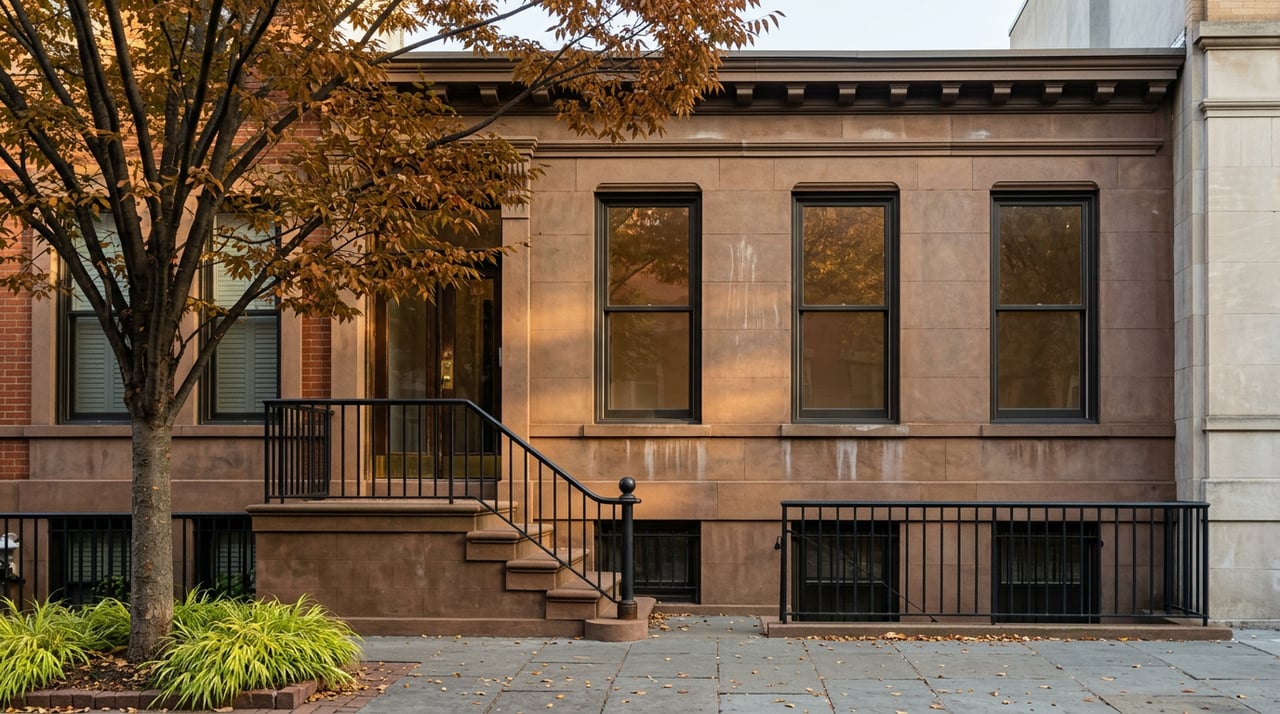
Cobble Hill's housing stock earned its character precisely because it kept changing hands and changing shape. Greek Revival, Gothic Revival, and Italianate rowhouses built as single-family homes in the mid-1800s have since been carved into co-ops and condos across the neighborhood. Cobble Hill Towers, a Dickensian-looking 1870s complex with its own ironwork and bluestone detailing, is one of the best known examples. Elsewhere in the neighborhood, former Victorian schoolhouses have been converted into loft-style co-ops, a Gothic Revival church has become condos, and old carriage houses have been turned into single-family homes.
That flexibility is part of what buyers are paying for. It's also exactly what makes the Certificate of Occupancy on file for any given address a poor match for what a listing photo shows. A house built for one family in 1875, occupied by three generations of the same family for eighty years, then rented out floor by floor during a slower market cycle, and finally listed today as a "legal three-family with income potential" may never have filed the paperwork that turns that description into fact.
What the City's Paper Actually Says
The Certificate of Occupancy is the Department of Buildings' record of how many legal dwelling units a building contains and what conditions each one has to meet. For a basement unit to count as a legal apartment, New York City's Department of Housing Preservation and Development sets specific conditions: at least half the space has to sit above curb level, ceilings need a minimum of 7 feet, every room needs a window, and the space needs its own approved means of getting out in an emergency. Cellars, defined as spaces with less than half their height above curb level, can never be legally rented at all, no matter how finished they look.
None of that is enforced by the seller pointing to a nicely renovated space. It's enforced against the Certificate of Occupancy on file, and if that document says two families where the house is actually running as three, the third unit doesn't exist as far as an appraiser, a lender, or the Department of Buildings is concerned.
That gap doesn't disappear when the prior owner is the one who created it.
The violation attaches to the property, and the property is now yours.
That's the plain description of how enforcement works from a law firm that handles these matters across the five boroughs. It doesn't matter that a previous owner built the unit, or that a listing once described the home as a legal multi-family, or that a buyer purchased in good faith. The Department of Buildings holds the current owner of record responsible, full stop.
Where the Gap Shows Up in a Real Transaction
The mismatch rarely kills a deal outright. It shows up quietly, in the numbers a lender and an appraiser are willing to sign off on.
| Configuration at listing | What underwriting sees | Effect on the price gap |
|---|---|---|
| Configuration matches the filed Certificate of Occupancy | Full legal use, full income potential if applicable | The neighborhood's price-per-square-foot discount is available to the buyer as advertised |
| An extra basement or garden unit is rented informally, with no amended Certificate of Occupancy | Appraiser values the legal unit count only; the extra rent doesn't factor into the appraisal | The buyer's financed offer comes in lower than the listing assumed, narrowing or erasing the discount |
| The structure was altered, excavated, or expanded without a permit or updated Certificate of Occupancy | An open Department of Buildings violation attaches to the current owner regardless of who did the work | Financed buyers drop out; the remaining buyer pool skews toward cash, often at a steeper discount than the seller planned for |
A house that looks identical from the stoop can land in any of those three rows depending entirely on what's filed downtown, not on what's visible on a walkthrough.
The 2026 Market Is Rewarding the Sellers Who Got the Paper Right
The dollar figures moving through Cobble Hill this year make the stakes concrete. Actors Daniel Craig and Rachel Weisz sold their home at 22 Strong Place for nearly $12 million in early 2026, almost double the $6.8 million they paid nine years earlier, according to The Real Deal's April reporting. The same week, a Cobble Hill townhouse asking $7 million secured a signed contract and took the top spot in a weekly report on Brooklyn's luxury deals. A renovated townhouse at 205 Clinton Street was on the market for $18.5 million as of that April report, marked down from an original $22 million ask, with no buyer yet at that price point.
What's notable about several of the year's top contracts is who was selling. Days earlier, in an April 7 report, The Real Deal noted that Cobble Hill's priciest deal of that week was a $6.75 million ask at 357 Henry Street, sold by an entity tied to developer Simkho Aranbayev, who had acquired the property as vacant land back in 2011 as part of a portfolio bought from real estate firm Time Equities. A 7,750-square-foot rebuild at 435 Henry Street, asking $13 million in June 2026 and designed by the Brooklyn Studio's Brendan Coburn for sellers Paul and Andrea Compton, went up as new construction with a concrete structure and brick facade rather than a converted multi-family. The Real Deal's own reporting notes that developers have been buying up properties across Brownstone Brooklyn in recent years and turning them into new single-family homes.
That's not a coincidence. A developer who files a Certificate of Occupancy that matches the finished product captures the full price-per-square-foot premium the neighborhood commands. A longtime owner who never updated the filing on a decades-old basement conversion is competing against those same comparable sales without the same paperwork behind them.
What to Check Before You List
None of this requires a lawyer's letterhead to start. It requires pulling the right documents in the right order, before a buyer's attorney pulls them for you.
- Request the current Certificate of Occupancy for the address through the Department of Buildings' public records, and compare the filed unit count against how the house actually functions today.
- Check for open Department of Buildings or Housing Preservation and Development violations tied to the address, since either agency can flag the same physical space for different reasons.
- If a basement or garden-level unit is part of the story you're telling buyers, confirm it clears the 7-foot ceiling minimum and has its own approved window and exit, the baseline HPD applies to any legally occupied basement space.
- If the configuration and the paper don't match, talk with counsel about the actual options: filing to legalize the extra unit through permitted work, restoring the space to its filed use before you list, or pricing and marketing the home honestly as what its paper says it is rather than what its layout suggests.
This is general information about how New York City documentation and underwriting typically work, not legal or financial advice for your specific property. A real estate attorney familiar with Brooklyn's historic housing stock is the right person to walk through what your Certificate of Occupancy actually allows.
A couple of questions worth asking directly
Does this apply to co-ops and condos in Cobble Hill, or just townhouses? The exposure concentrates in one- to three-family townhouses and converted rowhouses. Co-ops and condos are already built around a single filed configuration set out in the building's offering plan, so the kind of informal unit-by-unit drift described here is much less common once a building has gone through that conversion process.
Can a house with a mismatched Certificate of Occupancy still sell? Often, yes. Cash buyers can move forward on a property that's priced and disclosed honestly as what its filed paper says it is. The friction concentrates for financed buyers, since their lender's appraisal is built on the legal use, not the layout a listing describes.
If you're weighing what your Cobble Hill townhouse or brownstone is actually positioned to command, our seller's guide walks through pricing and prep, and a home valuation is a good place to start the conversation. For a closer look at pulling your Certificate of Occupancy and understanding exactly what it says about your property before you list, reach out to The Scott / Robles Team.